



Growing up gay in a heteronormative world can shape the way we see ourselves, relationships, safety, shame and belonging. There’s a particular kind of loneliness that can come from growing up feeling different before you even fully understand why. As a gay man growing up in the 1970s and 1980s, I often felt like I was moving through the world slightly out of step with everybody else. I knew very early on that I didn’t fit in, although at the time I didn’t have the language to explain what I was experiencing. I just knew I felt wrong somehow.
Looking back now, with the benefit of years of personal therapy, therapy training, self reflection, and several years working with LGBTQ+ clients, I can see that many of the struggles I experienced weren’t signs that there was something inherently wrong with me. They were understandable responses to growing up in environments that often felt unsafe, invalidating, and emotionally isolating.
SHAME, BULLYING AND LEARNING TO HIDE
A lot of LGBTQ+ people grow up learning to monitor themselves constantly. How am I speaking? How am I walking? Am I too emotional? Too sensitive? Too flamboyant? Too much? For many of us, this self monitoring becomes second nature long before we even come out.
I remember being called “Gay Gavin” at school from around the age of seven, years before I even properly understood what being gay meant. The nickname followed me throughout childhood. I still remember the shame attached to hearing it. Not because there was anything wrong with being gay, but because I absorbed the message that there was. I always say that i survived my childhood, I didn’t thrive, like many kids are able to do.
That’s one of the difficult things about shame. It rarely arrives as one big dramatic event. More often, it builds slowly through thousands of small moments: the comments, the looks, the laughter, the silence, and the feeling that parts of you are welcome, but other parts are not.
GROWING UP GAY IN A HETERONORMATIVE WORLD
Many LGBTQ+ people grow up in environments where heterosexuality is treated as the default. At school, other boys talked openly about girls they fancied. Teachers spoke about “future wives” and “girlfriends.” Television rarely showed LGBTQ+ people in healthy or affirming ways back then. When gay people did appear, they were often ridiculed, stereotyped, or treated as tragic.
That has an impact.
When you never see yourself reflected back positively, you start to internalise the idea that maybe you are the problem. Research around minority stress shows that LGBTQ+ people experience higher rates of anxiety, depression, substance misuse, and suicidal thoughts, not because there is something inherently unhealthy about being LGBTQ+, but because living in a society that repeatedly marginalises you takes a psychological toll.
HYPERVIGILANCE, PEOPLE PLEASING, AND SURVIVAL
I see this regularly in my work as a therapist. Many LGBTQ+ clients arrive in therapy carrying years of hypervigilance. They’ve become experts at reading rooms, monitoring people’s reactions, and adapting themselves in order to stay emotionally safe.
A lot of this begins in childhood. As children, we rely on affirmation and connection to help us develop a stable sense of self. But when acceptance feels uncertain or conditional, many people learn that authenticity comes with risk. Some become people pleasers. Some become perfectionists. Some emotionally withdraw. Some become hyper independent. Some lose themselves entirely in relationships. I became all of those things.
These strategies often begin as survival mechanisms. At the time, they make perfect sense. If being fully yourself risks rejection, ridicule, or abandonment, of course you adapt. The problem is that these survival strategies often continue long into adulthood, even after the original danger has passed.
THE EMOTIONAL COST OF SHAME
I spent years believing I had to reinvent myself in order to become acceptable. At one point after leaving school, I planned to change my name completely because I thought if I became somebody else, maybe people would finally like me. That’s the painful thing about shame. It doesn’t just make you dislike parts of yourself. It can make you believe that your entire self needs replacing.
And yet underneath all of that adaptation, there is often grief. Grief for the childhood you didn’t get. Grief for the confidence you never had the chance to develop. Grief for the years spent hiding. Grief for the relationships, experiences, and rites of passage that never felt emotionally safe to explore.
One of the things I often reflect on now is how many LGBTQ+ people never really get the opportunity to fully experiment with identity, intimacy, attraction, and belonging during adolescence in the same way many heterosexual people do. When your teenage years are dominated by fear, concealment, or shame, emotional development can become disrupted.
That doesn’t mean people are broken. It means they adapted.
MOVING FROM SHAME TO UNDERSTANDING
Therapy helped me begin making sense of this. Counselling training also gave me language and frameworks that helped me understand my own experiences differently. I began to see that what I once viewed as weakness was often actually protection.
Hypervigilance, people pleasing, fantasy, emotional monitoring, and wanting desperately to be liked were not personality defects. They were strategies developed in response to growing up in environments where safety and belonging often felt uncertain.
One of the most powerful parts of therapy can be helping people move from shame to understanding. Not excusing harmful behaviour or avoiding accountability, but understanding the context in which certain patterns developed. Because when people begin to understand themselves with compassion instead of contempt, something starts to soften.
HEALING AND RECONNECTION
Over time, many LGBTQ+ people begin reconnecting with parts of themselves that were hidden away for years. The playful parts. The emotional parts. The creative parts. The relational parts. The authentic parts.
Healing often involves learning that your worth was never dependent on how well you could perform acceptability. You were never supposed to earn the right to exist comfortably as yourself.
And although growing up in a heteronormative world can leave deep emotional wounds, those wounds do not have to define the rest of your life. Therapy can offer a space where you no longer need to monitor every part of yourself. A space where you don’t need to explain or defend your identity. A space where you can begin untangling shame from selfhood. A space where being fully yourself slowly starts to feel safe.
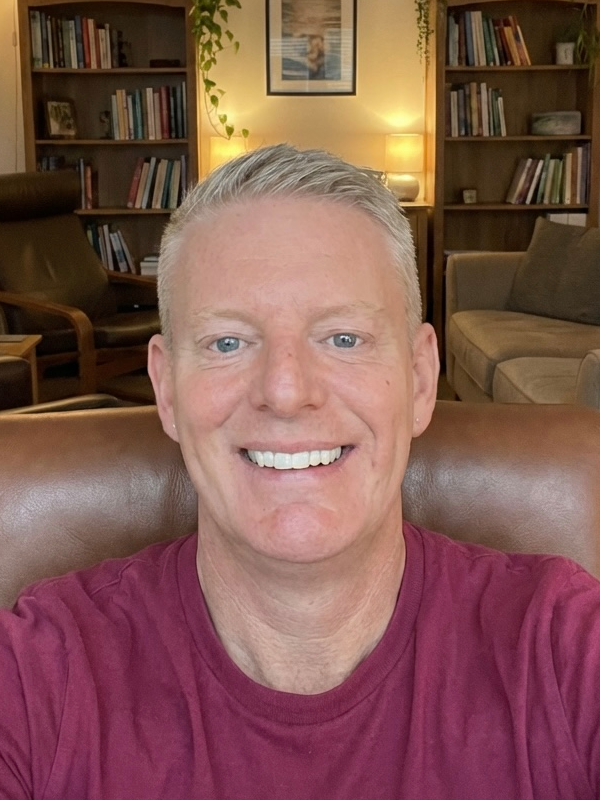
If any of this resonates with you and you’d like support exploring it further, I’m Gavin, a gay therapist in Manchester offering LGBTQ+ affirming therapy both online and in person. You’re welcome to get in touch to arrange a free 15 minute introductory call or view my BACP profile to learn more about how I work.