




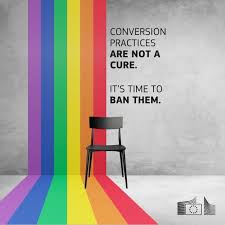
Conversion Practices Are Not Just Part of History
When people hear the phrase conversion practices, they often imagine something from the past. They picture religious interventions, coercive programmes, or outdated psychological approaches that disappeared decades ago. Many assume that conversion practices are relics of a less enlightened era and have no place in modern society.
Unfortunately, that assumption isn’t always correct.
Whilst overt attempts to change someone’s sexual orientation or gender identity have become less socially acceptable, the attitudes that underpin conversion practices haven’t disappeared. They can still be found in families, faith communities, schools, workplaces, political movements, and sometimes even within healthcare and therapy settings. They may not always be obvious and they may not always be intentional, but the underlying message often remains the same: that LGBTQ+ people would somehow be happier, safer, more acceptable, or more successful if they were different.
Conversion practices refer to any attempt to suppress, discourage, change, or deny a person’s sexual orientation or gender identity. Whether delivered through religion, healthcare, counselling, family pressure, or wider social expectations, they are built upon the assumption that LGBTQ+ identities are less desirable than heterosexual or cisgender identities.
Research has consistently linked conversion practices with increased rates of anxiety, depression, trauma, shame, self hatred, self harm, and suicidality. Major professional bodies across counselling, psychotherapy, psychology, and psychiatry agree that LGBTQ+ identities are not disorders requiring treatment.
The problem was never LGBTQ+ identities. The problem was the belief that LGBTQ+ people needed to become someone else.
Growing Up LGBTQ+ and Learning Shame
Many LGBTQ+ people have never experienced formal conversion practices, yet they have still grown up surrounded by messages that communicate a remarkably similar idea.
As a gay man who grew up during the 1980s, I remember a world shaped by Section 28, the AIDS crisis, and widespread hostility towards LGBTQ+ people. Many of us learned very early that there were consequences for being different. We became experts at reading the room, monitoring our behaviour, and assessing whether it was safe to be ourselves. For many LGBTQ+ people, those survival strategies don’t disappear simply because society becomes more accepting.
Some people hear directly that being LGBTQ+ is wrong, sinful, selfish, or unnatural. Others receive more subtle messages. They learn that acceptance is conditional. They learn that certain parts of themselves are welcome whilst others are not. They learn to shrink, adapt, or hide in order to maintain relationships and stay connected to family, friends, or community.
Over time these experiences can become internalised. Many LGBTQ+ adults carry a deep sense of shame without fully understanding where it came from. They may struggle with self esteem, relationships, intimacy, authenticity, or belonging. They may spend years trying to become more acceptable rather than learning to accept themselves.
This is where minority stress becomes important. Minority stress theory suggests that many of the mental health difficulties experienced by LGBTQ+ people aren’t caused by their identities. They are often the result of living within environments that communicate rejection, stigma, discrimination, or conditional acceptance.
Many LGBTQ+ people didn’t learn to hate themselves in therapy. They learned it through years of subtle and not so subtle messages that who they were wasn’t acceptable.
How Conversion Practices Can Appear in Therapy
Most therapists would strongly oppose overt conversion practices. However, that doesn’t mean therapy is automatically free from their influence.
Conversion practices can emerge in subtle ways when therapists lack understanding of LGBTQ+ experiences or fail to recognise their own biases. A therapist may repeatedly search for the cause of someone’s sexuality as though it requires explanation. They may assume that a trans person’s distress reflects confusion about their identity rather than recognising the impact of discrimination, hostility, and minority stress. They may encourage clients to prioritise family acceptance over authenticity, or suggest that life would be easier if they were less open about who they are.
Sometimes the harm lies not in what is explicitly said but in what is implied. A client may leave therapy feeling that their identity has been analysed, questioned, or treated as a problem to solve. The therapist may never have intended to communicate that message, but intent and impact aren’t always the same thing.
I’ve spoken to many LGBTQ+ people who have left therapy feeling less understood than when they entered it. The therapist may have been well meaning, but good intentions alone don’t guarantee affirming practice.
Therapy should help people understand themselves more fully. It shouldn’t be used to steer people towards identities, relationships, or lifestyles that feel more comfortable for the therapist or wider society.
Sometimes the harm lies not in what is explicitly said, but in what is implied.
Therapist Bias and the Importance of Self Reflection
One of the biggest lessons I’ve taken from my specialist training in Gender, Sexuality and Relationship Diversity Therapy is that self reflection isn’t optional. It is an ethical responsibility.
Therapists are human beings. We all bring our experiences, assumptions, values, and biases into the therapy room. No therapist is completely neutral. The question isn’t whether we have biases. The question is whether we’re willing to recognise them and reflect upon how they might influence the therapeutic relationship.
My own identity as a gay man inevitably influences how I understand the world. My experiences of growing up LGBTQ+, navigating shame, and finding acceptance have shaped me personally and professionally. Those experiences can help me empathise with clients, but they can also create assumptions if I’m not careful.
Through my GSRD training and Advanced Accreditation with Pink Therapy, I’ve been encouraged to continually examine how my own identity, experiences, and worldview may influence my work. Shared identity doesn’t automatically mean shared experience. A young trans person, a bisexual woman from a conservative faith background, a non binary person of colour, and a gay man may all have very different experiences of the world.
Good LGBTQ+ affirming therapy isn’t about having all the answers. It’s about remaining curious enough to recognise when our own assumptions might be getting in the way.
Intersectionality, Colonialism and Patriarchy
Being LGBTQ+ affirming isn’t simply about accepting LGBTQ+ people. It also requires an understanding of the wider systems that shape people’s lives.
Every person enters therapy with multiple identities. Sexual orientation and gender identity are only part of the story. Race, ethnicity, disability, religion, age, culture, and social class all influence how people experience the world. This is where intersectionality becomes important.
Developed by Kimberlé Crenshaw, intersectionality recognises that different forms of oppression and privilege overlap and interact with one another. People don’t experience homophobia, transphobia, racism, sexism, ableism, or classism in isolation. These experiences often intersect and compound one another.
An intersectional perspective also encourages us to understand the historical origins of many anti LGBTQ+ attitudes. Before colonisation, many cultures recognised a far wider range of sexualities and gender identities than those accepted within modern Western society. Colonial powers frequently imposed laws, religious beliefs, and moral frameworks that criminalised or condemned sexual and gender diversity. Many of those laws remain in place today.
Patriarchy has also played a significant role. Rigid expectations around masculinity and femininity continue to shape how people are expected to behave. Gay men may face criticism for being perceived as feminine. Lesbians may be criticised for rejecting traditional gender roles. Trans and non binary people often face hostility simply because their existence challenges binary assumptions about gender.
Without understanding these wider systems, therapy risks locating the problem within the individual rather than recognising the social context in which distress developed.
The problem isn’t LGBTQ+ identities. The problem is the systems that have historically sought to regulate, suppress, and control them.
What Makes Therapy Truly LGBTQ+ Affirming?
LGBTQ+ affirming therapy starts from a fundamentally different position. Rather than viewing LGBTQ+ identities as problems, affirming therapy recognises them as natural and valid expressions of human diversity.
An affirming therapist understands concepts such as minority stress, internalised stigma, identity development, discrimination, trauma, and social exclusion. They recognise the impact that rejection, invisibility, bullying, prejudice, and conditional acceptance can have on mental health. Rather than asking how someone can change, affirming therapy asks how someone can better understand themselves.
The goal isn’t to help someone become more acceptable to other people. The goal is to help them develop greater self acceptance, self compassion, and authenticity.
Specialist training matters because it helps therapists move beyond simple acceptance towards deeper understanding. Clients deserve more than tolerance. They deserve therapists who are informed, reflective, culturally aware, and committed to ongoing learning.
The goal isn’t conformity. The goal is self acceptance.
Final Thoughts
Conversion practices have no place in ethical therapy. Whether they appear as overt attempts to change someone or subtle efforts to suppress authenticity, the impact can be deeply damaging.
Therapy shouldn’t be about helping people become someone else. It should be about helping people understand who they are, heal from the wounds they have experienced, and build lives that feel meaningful, connected, and authentic.
Therapy shouldn’t help people become someone else. It should help them become more fully themselves.
If you’re LGBTQ+ and considering therapy, it can be helpful to ask potential therapists about their training, experience, and understanding of LGBTQ+ challenges, relationships and lives. Finding an affirming therapist can make a significant difference to feeling safe, understood, and supported.
If any of this resonates with you and you’d like support exploring it further, I offer LGBTQ+ affirming therapy both online and in person from my practice in Manchester city centre. You’re welcome to get in touch to arrange a free 15 minute introductory call.