


Many LGBTQ+ people grow up carrying painful beliefs about themselves long before they have the language to understand where those beliefs came from. Sometimes those beliefs are obvious, sometimes they sit quietly underneath everything, shaping relationships, confidence, anxiety, self worth, and the way we move through the world without fully realising it.
Negative core beliefs are often the invisible thread running underneath many mental health struggles. They can shape how we see ourselves, what we expect from other people, and what we believe we deserve. For many LGBTQ+ people, these beliefs don’t appear out of nowhere. They are often built slowly through years of shame, rejection, silence, bullying, exclusion, fear, or feeling different. After a while, those experiences can stop feeling like experiences and start feeling like identity.
WHAT ARE NEGATIVE CORE BELIEFS?
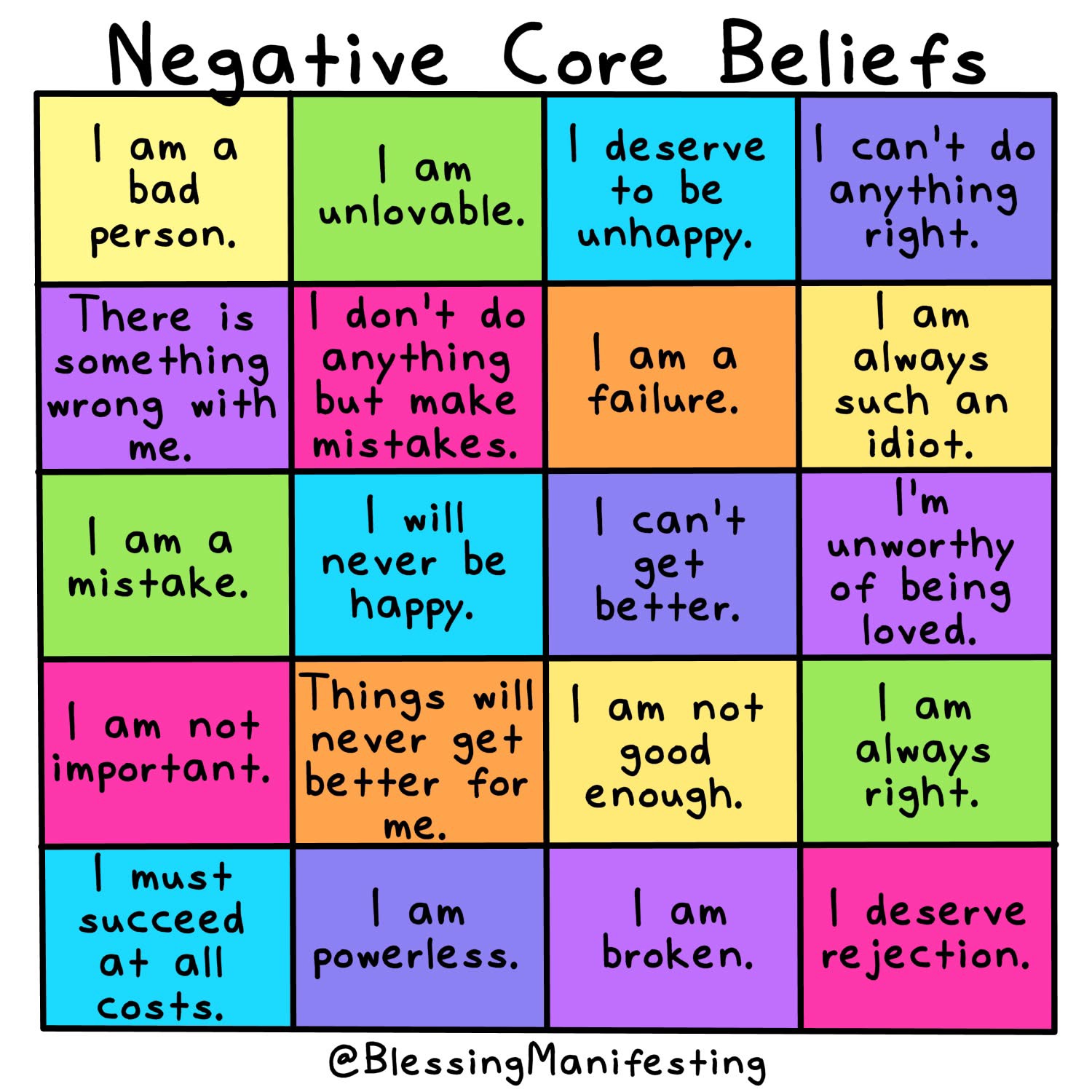
Negative core beliefs are deeply held assumptions we develop about ourselves, other people, and the world around us. They often begin forming in childhood and adolescence through repeated emotional experiences and, over time, become internalised until they start feeling unquestionably true.
Common examples include beliefs such as “I’m not good enough”, “I’m unlikeable”, “I’m too much”, “I don’t belong”, “People will reject me”, or “I have to hide parts of myself to be accepted”. These beliefs don’t usually sit at the surface of awareness all day long. Instead, they operate quietly in the background, influencing emotions, behaviours, relationships, and reactions to stress.
Someone may not consciously think “I’m unlovable”, but they might constantly seek reassurance, fear abandonment, over analyse messages, or tolerate poor treatment because deep down they already expect rejection. That’s how core beliefs work, they become the lens through which we interpret life.
HOW NEGATIVE CORE BELIEFS DEVELOP IN LGBTQ+ PEOPLE
For many LGBTQ+ people, shame starts early. Sometimes it comes through overt bullying, rejection, hostility, or emotional neglect. Other times it develops more subtly through silence, casual comments, social expectations, religious messaging, or simply feeling different from the people around us.
Growing up LGBTQ+ often means becoming hyperaware of yourself from a very young age. You notice the way people react to femininity in boys, masculinity in girls, gender nonconformity, vulnerability, emotion, or difference. You quickly learn what feels safe and what doesn’t.
Maybe you stopped expressing parts of yourself, monitored your voice, your mannerisms, your interests, or your body language. Maybe you laughed along with homophobic jokes because it felt safer than standing out. Many LGBTQ+ people became experts at reading the room long before they became adults.
I remember desperately wanting dance lessons as a child after seeing my sister attend classes. The owner of the dance school had asked whether I’d like to join too. I wanted to say yes, but it didn’t feel safe. Agreeing felt loaded with meaning, as though saying yes would somehow confirm something I was already trying desperately to hide. Looking back now, I can see how early shame and fear can begin shaping the choices we make and the parts of ourselves we suppress simply to feel safe.
Over time, repeated experiences of non affirmation can slowly shape identity. If people repeatedly react negatively to parts of who you are, it becomes easy to internalise the belief that something must be wrong with you. That’s how shame becomes embedded.
For some people these experiences were severe, involving bullying, family rejection, violence, religious condemnation, or emotional abandonment. For others, it was cumulative, thousands of smaller moments reinforcing the same message over and over again, don’t be too visible, don’t be too different, don’t take up space, don’t let people fully see you. Eventually those external messages can become internal beliefs.
I was bullied at school and often hid it from my parents because admitting what was happening felt too exposing. Deep down, I believed that if I acknowledged why I was being bullied, I would somehow also be admitting something shameful about myself. The shame became bigger than the bullying itself.
THE DIFFERENCE BETWEEN THOUGHTS AND CORE BELIEFS
A difficult interaction on its own usually doesn’t create a core belief. Core beliefs develop through repetition and emotional reinforcement over time.
A thought might be, “They haven’t replied to my message”, but the deeper belief underneath could be, “I’m unwanted”, “I’m too much”, or “People always leave”. This is why certain situations can trigger emotional reactions that feel much bigger than the situation itself.
A delayed text reply can suddenly feel overwhelming, criticism can trigger intense shame, or a disagreement can feel catastrophic. Many people don’t realise they are reacting not only to the present moment, but also to years of accumulated emotional experiences sitting underneath the surface.
HOW NEGATIVE CORE BELIEFS AFFECT RELATIONSHIPS
Negative core beliefs can shape relationships in powerful ways. If somebody deep down believes they are unworthy of love, they may struggle to believe reassurance even when it is genuine. Compliments can feel uncomfortable, healthy relationships may feel unfamiliar, and emotional safety can sometimes feel harder to trust than emotional chaos.
Some people become highly anxious in relationships, constantly monitoring for signs of rejection, abandonment, or emotional withdrawal. Others distance themselves emotionally before people can get too close. Some over function in relationships, prioritising everybody else’s needs while abandoning their own.
Many LGBTQ+ people learned early on that acceptance could feel conditional. That can create a deep fear that connection, love, or belonging could disappear if they disappoint people or become fully visible.
This often shows up through people pleasing, perfectionism, emotional suppression, fear of conflict, over analysing interactions, struggling with boundaries, constantly needing reassurance, hiding needs to avoid rejection, or tolerating unhealthy dynamics because poor treatment feels familiar.
None of these responses are signs of weakness. In many ways they were intelligent adaptations developed to survive emotionally difficult environments. The problem is that survival strategies which protected us in childhood can become painful limitations in adulthood.
WHY CORE BELIEFS CAN FEEL SO TRUE
One of the hardest things about negative core beliefs is that they rarely feel like beliefs, they feel like facts. When a belief has been reinforced over years, the brain automatically starts looking for evidence that confirms it while dismissing evidence that contradicts it.
If somebody believes “I’m unlikeable”, they may focus intensely on rejection while overlooking warmth, connection, or acceptance. If somebody believes “I don’t belong”, they may walk into social spaces already expecting exclusion, becoming hypervigilant to signs of judgement or disapproval.
This creates a painful cycle where old beliefs continuously reinforce themselves.
Many LGBTQ+ people also carry minority stress, the ongoing stress associated with living within a society where prejudice, stigma, discrimination, or non affirmation still exist. That means these beliefs are often not purely internal, they are reinforced by real world experiences too.
Reading books like The Velvet Rage by Alan Downs and Straight Jacket by Matthew Todd helped me begin understanding how shame had woven itself through so many parts of my own life. Through therapy, reflection, and training, I slowly began recognising many of the strategies I had developed over the years to avoid shame without even consciously realising I was doing it.
This is why healing isn’t simply about “thinking positively”. It’s about understanding how these beliefs formed, recognising the emotional pain underneath them, and gradually building new experiences that challenge old narratives.
THE INNER CRITIC AND SHAME
Many people with strong negative core beliefs develop a harsh inner critic. The inner critic often sounds controlling, demanding, perfectionistic, or cruel, criticising appearance, behaviour, emotions, vulnerability, or identity.
Underneath that criticism is often fear. For many LGBTQ+ people, the inner critic developed as a protective strategy. If you could monitor yourself closely enough, perhaps you could avoid bullying, humiliation, rejection, abandonment, or danger.
The critic often believes it is keeping you safe.
The difficulty is that over time self criticism becomes exhausting. It can lead to anxiety, burnout, perfectionism, depression, low self esteem, emotional dysregulation, and chronic feelings of inadequacy. Many people spend years trying to outrun shame through achievement, relationships, appearance, work, sex, alcohol, substances, validation, or perfectionism, only to find the shame still sitting underneath everything.
Shame rarely disappears through proving ourselves. More often it begins healing through compassion, connection, visibility, emotional safety, and being accepted as we are.
HEALING NEGATIVE CORE BELIEFS
Healing negative core beliefs takes time. These beliefs were often built over years or decades, so it makes sense they don’t disappear overnight. But they can change.
Therapy can help people begin recognising the origins of their beliefs rather than automatically accepting them as truth. For many LGBTQ+ people, healing involves recognising that many painful beliefs formed within environments that were non affirming, invalidating, or unsafe.
It can involve grieving what was missing, understanding survival strategies with compassion, and learning to separate identity from shame.
Healing often includes developing self awareness, recognising shame responses, building emotional safety, challenging avoidance patterns, learning boundaries, experiencing affirming relationships, reconnecting with authenticity, finding community, and developing greater self compassion.
For many people, healing means moving from survival into fuller self acceptance. Not because life suddenly becomes perfect, but because the relationship with yourself slowly changes.
WHY LGBTQ+ AFFIRMING THERAPY MATTERS
For LGBTQ+ people, therapy can sometimes become another place where shame is reinforced if the therapist lacks understanding of LGBTQ+ identities and experiences. Affirming therapy matters because it understands the wider social and cultural context people exist within. It recognises minority stress, shame, identity development, rejection, visibility, and the psychological impact of growing up in environments where parts of yourself may not have felt fully accepted.
Good therapy isn’t about changing LGBTQ+ identity, it’s about helping people untangle shame from selfhood. It’s about creating a space where somebody no longer has to edit themselves to feel accepted.
For many people, that experience alone can be deeply healing.
MOVING TOWARDS SELF ACCEPTANCE
Negative core beliefs can make people feel trapped inside old versions of themselves. Many LGBTQ+ people spend years surviving environments that taught them to shrink, hide, adapt, or perform safety for acceptance. It makes sense those experiences leave marks.
But beliefs formed through pain are not permanent truths.
Through therapy, self reflection, affirming relationships, community, and compassion, people can begin developing a different relationship with themselves, one built less around shame and more around authenticity, less around fear and more around connection, less around survival and more around living.
If any of this resonates with you and you’d like support exploring it further, I offer LGBTQ+ affirming therapy both online and in person from my practice in Manchester city centre. Therapy can provide a space to better understand the origins of negative core beliefs, explore the impact shame may have had on your sense of self, and begin developing a more compassionate and authentic relationship with yourself.
I offer a free 15 minute introductory call where we can briefly talk about what’s bringing you to therapy and whether we feel like the right fit to work together. There’s no pressure or obligation to continue afterwards.